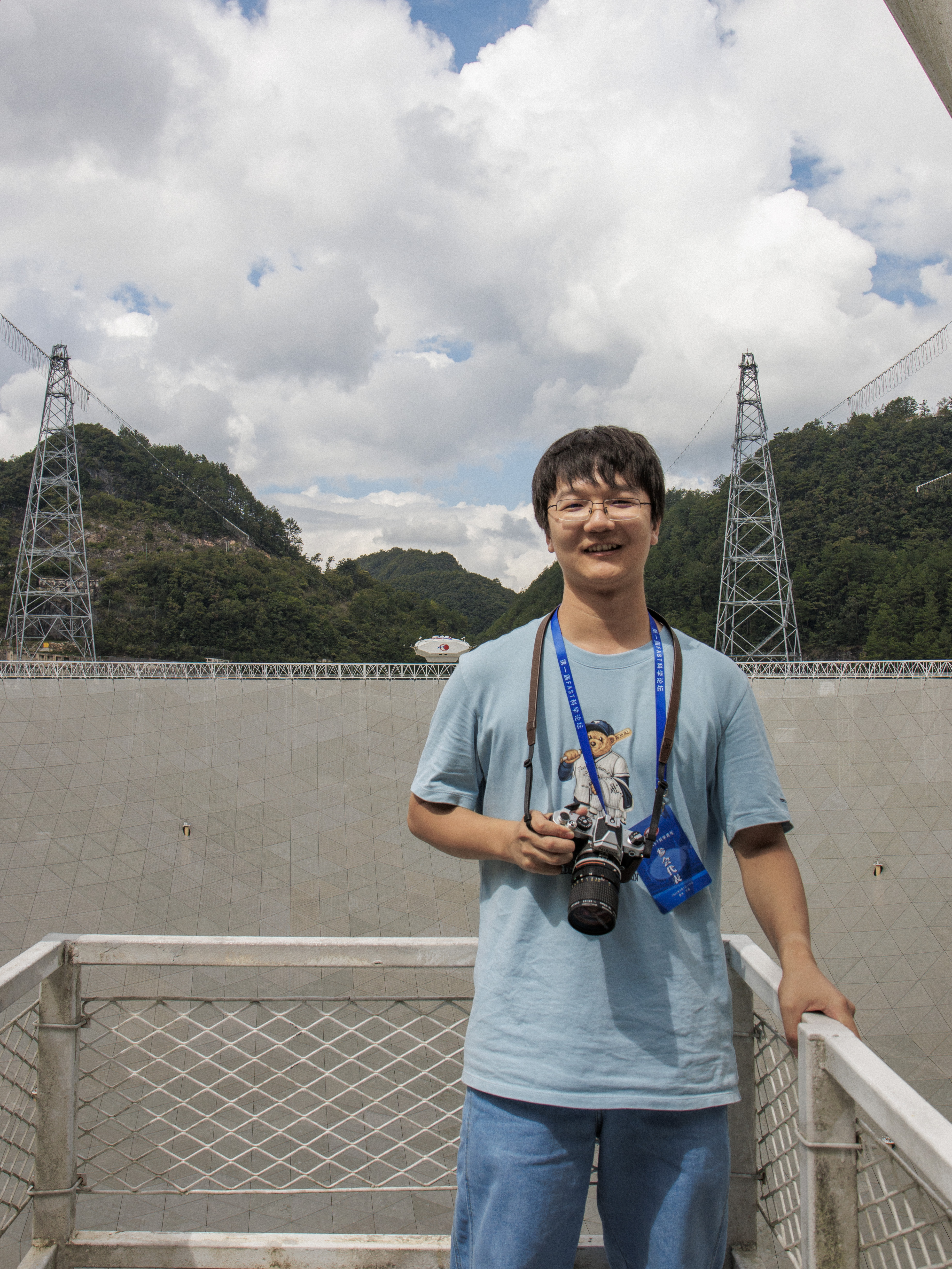
About Me
I am Shi-Jie Gao (高世杰), a postdoctoral researcher at the School of Astronomy and Space Science, Nanjing University. My research currently follows two distinct directions: theoretical studies of the formation and evolution of compact-object binaries, and radio observations of pulsars and transients. In future work, I aim to connect these theoretical and observational directions.
Research Focus
Compact-object binaries. I study how compact-object and X-ray binaries form and evolve, with interests spanning binary pulsars, white-dwarf binaries, and possible formation channels for mass-gap black holes.
Radio pulsars and transients. My current work emphasizes pulsar and transient searches and pulsar polarization studies using FAST, the Green Bank Telescope, and the Parkes 64-m radio telescope (Murriyang).
Selected Highlights
- Detected more than 30 pulsars in FAST data; the Pulsar Gleaners page lists those identified in publicly available FAST observations.
- Discovered PSR J1750-3116A, the first radio pulsar associated with the globular cluster Terzan 6, through a direct high-frequency search with the Green Bank Telescope.
- Studied RRAT J2325-0530, a rotating radio transient with an atypical waiting-time distribution.
- Investigated compact-object binary evolution and possible routes to forming mass-gap black holes.
- Helped commission Nanjing University’s 4.5-m radio telescope and detect signals from eight pulsars for teaching and public outreach.
Background
I studied physics at Shandong University and completed my Ph.D. in astronomy at Nanjing University. My doctoral research focused on compact-object and X-ray binary evolution; my postdoctoral work places greater emphasis on radio pulsar and transient searches.
I enjoy problems where physical modeling meets real data: how compact-object binaries form, how weak pulsar signals emerge from noisy observations, and what these systems reveal about stellar evolution.